AI Search Optimization in 2026: How to Get Found in ChatGPT, Google AI, Perplexity and Gemini
Updated: September 2026 Reading time: approximately 18 minutes
People are no longer using search engines in only one way. A potential customer can still type a short phrase into Google, but they can also ask ChatGPT to recommend a local developer, use Google AI Mode to compare service providers, ask Perplexity for the best option in a category, or use Gemini to research a purchase before contacting anyone.
That shift creates a new visibility problem for businesses. Ranking on page one is still valuable, but it is no longer the only question. Businesses also need to ask: Can AI systems find us, understand what we do, trust the information they find, and confidently cite or recommend us in an answer?
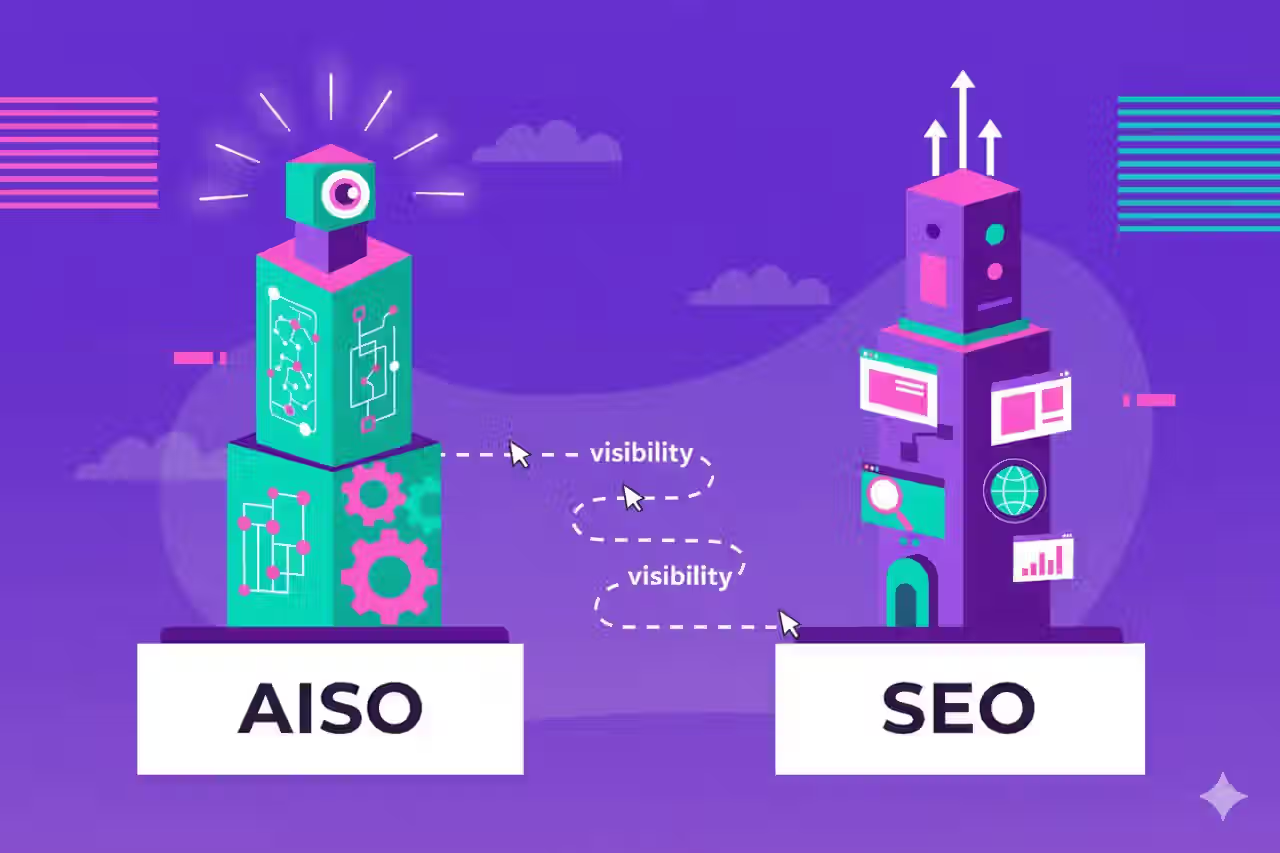
This is where AI Search Optimization, sometimes called AISO, Answer Engine Optimization or Generative Engine Optimization (GEO), comes in. The useful work combines technical SEO, clear business entities, strong commercial information, structured data, original expertise, trustworthy third party references and measurement.
Google now says this directly. Its 2026 guidance explains that AI Overviews and AI Mode still rely on core Search ranking and quality systems, with no need for special AI files or special schema.
The opportunity is real, but the right approach is much more disciplined than adding an llms.txt file and calling the site “AI optimized.”
AI Search Optimization: Quick Answer
- AI Search Optimization improves how easily AI powered search systems can discover, interpret, validate and cite your business.
- Traditional SEO still matters because many AI search experiences retrieve information from web search indexes and public web pages.
- Technical crawlability matters. ChatGPT Search uses OAI-SearchBot, Perplexity uses PerplexityBot, and Google AI features depend on content that can be indexed in Google Search.
- Structured data can improve machine understanding and rich result eligibility, but there is no universal “AI schema” that guarantees citations.
- Clear service pages, product information, expert content, business details and external corroboration give AI systems stronger evidence about what your company does.
- An
llms.txtfile is not a substitute for technical SEO, content quality or entity clarity. Google explicitly says it ignores the file for Search. - AI visibility should be measured using a repeatable prompt set, citation tracking, referral traffic, conversions and platform specific reporting.
- The best entry point for most businesses is an AI Visibility Audit that identifies technical, content, entity and reputation gaps before implementation work begins.
What Is AI Search Optimization?
AI Search Optimization is the process of improving a business’s visibility, clarity and credibility across AI powered search and answer systems. The goal is to make it easier for systems such as ChatGPT, Google AI Overviews, Google AI Mode, Perplexity and Gemini to retrieve accurate information about the business and use that information when generating useful answers.
You may also see the term Generative Engine Optimization, or GEO. Google considers GEO and AEO part of SEO because its generative experiences are built on Search. A cross platform AI visibility strategy still needs to account for crawler rules, citation patterns, entity signals and measurement across other systems.
A useful AI Search Optimization strategy asks four questions:
- Discovery: Can the relevant system access and retrieve the business’s public information?
- Understanding: Is it clear what the business is, what it sells, where it operates and who it serves?
- Trust: Is that information supported by strong first party content and credible third party sources?
- Measurement: Can the business track AI visibility, citations, referral traffic and resulting leads or sales?
If one of those layers is weak, publishing more blog posts is not automatically the answer.
How AI Search Visibility Works in 2026
There is no single AI search index used by every platform. ChatGPT, Google, Perplexity and Gemini use different products, retrieval systems and crawler controls, so a tactic that affects one platform may do nothing on another.
Google says AI Overviews and AI Mode can use retrieval augmented generation and query fan out. One question can trigger several related searches, allowing Google to retrieve supporting pages even when the original prompt does not exactly match their wording.
Gemini can use Google Search grounding to retrieve current web information and citations. Perplexity searches the web and links answers to original sources. OpenAI says public websites can appear in ChatGPT Search and recommends allowing OAI-SearchBot for discovery and citation.
Developer Insight
This is why AI Search Optimization cannot be reduced to keyword density. Modern answer systems may retrieve several pages, compare evidence, search related subtopics, use external sources and then generate a response. The job is to make the business easy to retrieve and hard to misunderstand.
1. Make Sure AI Search Systems Can Access the Site
Before improving content, confirm that the systems you care about can actually reach it.
For Google AI features, a page must be indexed and eligible to appear in Search with a snippet. The usual technical fundamentals still apply: crawling, textual content, internal links, correct indexing controls and renderable JavaScript.
For ChatGPT Search, OpenAI says publishers should allow OAI-SearchBot. Search discovery and model training use separate crawler controls, so OAI-SearchBot and GPTBot can be managed independently.
Perplexity says its PerplexityBot follows robots.txt. If the crawler is blocked, Perplexity says it will not index the full or partial text content from that site through PerplexityBot.
Technical checks for an AI visibility audit
- robots.txt rules for major search and AI crawlers
- HTTP status codes and redirect chains
- CDN, firewall and bot protection rules
- canonical tags and accidental duplicate URLs
- noindex and snippet controls
- XML sitemap coverage
- JavaScript rendering of important content
- internal linking to important service and product pages
- mobile usability and page performance
- accessible page structure for emerging browser agents
A site can publish excellent content and still create an AI visibility problem at the infrastructure layer.
2. Build a Clear Business Entity
An AI system should not have to guess who the company is.
Business name, location, service area, contact information, logo, profiles and core services should be consistent across the website and authoritative external sources. Local businesses should also keep Google Business Profile information accurate.
Google’s Organization structured data documentation specifically says organization markup can help it understand administrative details and disambiguate one organization from another. LocalBusiness markup can provide location, contact, hours and other operational details where appropriate.
Entity clarity usually includes
- a strong About page, consistent contact information and clear service areas
- accurate Google Business Profile and relevant business listings
- Organization or LocalBusiness structured data where appropriate
- legitimate social profiles, authorship, case studies and portfolio evidence
For a service business, “we do digital solutions” is weak entity information. “We build Shopify stores, WordPress websites and React applications for Canadian and US businesses” gives both people and machines something concrete to understand.
3. Create Pages That Clearly Explain What You Sell
Many websites hide their most important commercial information behind vague marketing copy.
If you want an AI system to recommend your business for a specific need, the site should contain a useful page that clearly explains that service or product. That page should answer the same questions a serious buyer would ask before contacting you.
A strong service page should usually explain
- what the service is, who it is for and which problems it solves
- the delivery process and important technical capabilities
- location, service area, scope or pricing guidance when relevant
- proof, common questions and the next step for a qualified customer
This is one reason a dedicated AI Search Optimization service page makes sense for Prime Pixels. A blog article can educate. A service page should make the commercial offer explicit: audit, implementation, content and entity improvements, monitoring, reporting and ongoing optimization.
4. Use Structured Data Properly, Not as an AI Shortcut
Structured data helps search engines understand specific types of information on a page and can make a site eligible for richer search features. Useful types can include Organization, LocalBusiness, Product, Article, Breadcrumb, ProfilePage, JobPosting and other schema that matches the visible content.
It is still worth implementing. It is simply not a magic “GEO schema.”
Google’s 2026 generative AI guidance is explicit that there is no special schema.org markup required for AI Overviews or AI Mode. Google also warns against overfocusing on structured data as if markup alone will create generative search visibility.
Developer Insight
Good schema should make true information easier to interpret. It should not be used to manufacture expertise, reviews, locations or services that are not clearly supported by the visible page.
The practical approach is to audit the structured data already present, remove conflicting or duplicated markup, add the types that genuinely fit the site, validate them and make sure the markup matches what a visitor can actually see.
5. Publish Expert Content That Adds Something New
Generic content is becoming easier to produce and less useful as a differentiator.
Google’s current guidance for generative AI search specifically recommends unique, valuable and non commodity content. That can include firsthand experience, original analysis, real examples, testing, data, photography, video, technical explanations, pricing breakdowns, comparison frameworks and lessons learned from actual work.
For a professional service business, the strongest content often comes from questions already being answered in sales calls, project meetings and support emails.
Examples of stronger expert content
- a contractor explaining why renovation estimates change
- a Shopify developer showing how a performance problem was diagnosed
- a manufacturer publishing real specification and compatibility information
- a local service business publishing accurate timing and pricing information
The goal is not to generate hundreds of pages for every possible AI prompt. Google specifically warns against scaled content created mainly to manipulate search visibility. The stronger strategy is to publish fewer pages that contain information a model would actually have a reason to retrieve and a customer would have a reason to trust.
7. Answer the Questions Customers Actually Ask
AI search is conversational. People ask complete questions, add constraints, compare options and refine their requests.
That makes clear answer content valuable, especially when it reflects real customer intent. Useful FAQ sections, comparison pages, pricing explanations, process pages and technical guides can all make a site easier to retrieve for specific questions.
The key is to answer the question directly before expanding into context. Do not bury a simple answer under five paragraphs of introduction.
For example
A weak heading says: Our Approach to Better Digital Experiences.
A stronger heading says: How Much Does a Custom Shopify Store Cost in Canada?
The second version clearly establishes the topic, user intent and expected answer. That is good for people first. It also gives search and answer systems cleaner context.
FAQ content should still be written for customers, not as a list of awkward keyword variations. Google’s current generative search guidance says there is no need to rewrite every page into tiny “AI chunks” or create a page for every phrasing of the same question.
Does llms.txt Help With AI Search Visibility?
llms.txt is a proposed text file that can provide AI systems with a concise map or summary of a website. It has received attention because it sounds like an AI equivalent of robots.txt or a sitemap.
It should not be treated that way.
Google’s 2026 documentation says Google Search does not use llms.txt for its generative search features and that adding the file does not improve Google Search visibility or rankings. Google’s advice is that businesses can maintain one for other systems if they have a reason to do so, but it is not required for Google.
OpenAI’s current ChatGPT Search guidance focuses on OAI-SearchBot access, robots.txt and public page availability, while Perplexity documents its own crawler controls. That makes llms.txt an optional experiment, not the foundation of an AI Search Optimization strategy.
From the Prime Pixels Team
If a site’s service pages are vague, its company information conflicts across platforms, its important content is blocked by a firewall and nobody credible references the business, adding one text file at the root of the domain does not solve the real problem.
How to Measure AI Search Visibility
AI visibility is harder to measure than a traditional keyword position because generated answers can vary by wording, location, context and platform. Measurement therefore needs to be repeatable.
1. Build a prompt set
Create a controlled list of prompts that represent real customer intent. Include discovery, comparison, local, product, service and problem based questions.
For a web development company, that might include prompts such as:
- Who builds custom Shopify stores for Canadian businesses?
- What agency can build a React dashboard with Stripe subscriptions?
- Which web developers work with both WordPress and Shopify?
- Who can improve a slow Shopify store?
2. Track brand mentions and citations
Record when the brand appears, where it appears in the answer, which pages are cited, which competitors appear and which source domains seem to influence the result.
3. Track AI referral traffic
OpenAI says ChatGPT referral links include utm_source=chatgpt.com, which can help publishers identify traffic coming from ChatGPT Search. Analytics should also be reviewed for other identifiable AI referrers.
4. Use Google Search Console’s generative AI reporting
Google introduced dedicated generative AI performance reporting in Search Console in 2026 and says the reporting was rolled out to websites worldwide by August 31, 2026. This gives businesses a first party way to review visibility from generative AI features on Google Search.
5. Measure business outcomes
A citation is useful, but the business still needs to know if AI discovery leads to qualified sessions, enquiries, calls, purchases or other meaningful actions.
Developer Insight
Do not turn “AI visibility score” into another vanity metric. A useful report should connect prompt visibility to source pages, referral traffic and business outcomes, then identify what needs to change next.
What an AI Visibility Audit Should Include
For many businesses, an audit is a better starting point than a monthly retainer. It creates a baseline, exposes technical blockers and shows where the largest opportunities actually are.
| Audit Area | What We Review | Why It Matters |
|---|---|---|
| Crawler access | robots.txt, OAI-SearchBot, PerplexityBot, Googlebot, WAF and CDN rules | Important pages need to be accessible to the systems you want to reach. |
| Indexability | status codes, canonicals, noindex, sitemaps and rendering | Retrieval starts with pages that can be found and processed correctly. |
| Entity clarity | business name, services, locations, profiles and company information | Reduces ambiguity about who the business is and what it does. |
| Structured data | Organization, LocalBusiness, Product, Article and other applicable markup | Provides explicit machine readable context where supported. |
| Commercial pages | service, product, category, location and comparison pages | Gives AI systems useful pages to retrieve for buying intent. |
| Expert content | originality, depth, authorship, examples, data and FAQs | Creates information worth citing instead of commodity copy. |
| External validation | reviews, directories, mentions, partner references and profiles | Provides corroborating information beyond the company’s own website. |
| Prompt visibility | repeatable tests across ChatGPT, Google AI, Perplexity and Gemini | Establishes a baseline and identifies competitor gaps. |
| Measurement | Search Console, analytics, referral traffic and conversions | Connects visibility work to actual performance. |
The output should not be a generic score. It should be a prioritized plan showing what is broken, what is missing, what should be created and what can be measured after implementation.
AI Search Optimization Is Also Preparing for Agentic Search
The next stage goes beyond answering questions. Browser agents are beginning to interpret websites, compare options and complete actions for users. Google now points businesses toward agent friendly site practices, while OpenAI notes that browser agents can use accessibility information such as ARIA labels and roles to understand interactive elements.
The practical move is not to rebuild a site around speculative protocols. Build clean, accessible, well structured pages with understandable controls and reliable business data, then monitor the standards major platforms actually adopt.
Developer’s Verdict: AI Search Optimization Is Real, but the Shortcuts Are Not
AI Search Optimization is worth taking seriously because customer discovery is spreading across AI powered search and answer systems. The goal is not to “trick ChatGPT.” It is to make the business easier to discover, understand, verify and cite.
Start with technical access. Make the company entity clear. Build strong service and product pages. Use structured data where it genuinely applies. Publish information based on real expertise. Strengthen credible third party references. Then measure visibility using a controlled prompt set, platform reporting, analytics and conversions.
The businesses that do this well should be in a stronger position not only for Google rankings, but also for the search experiences and AI agents that increasingly sit between a customer and the websites they choose to visit.
Frequently Asked Questions About AI Search Optimization
What is AI Search Optimization?
AI Search Optimization improves how easily AI powered search systems can discover, understand, verify and cite a business through technical SEO, entity clarity, content, authority and measurement.
What is Generative Engine Optimization or GEO?
Generative Engine Optimization describes work intended to improve visibility in AI generated search and answer experiences. Google treats GEO and AEO as SEO for its own Search products.
Can I optimize my website to appear in ChatGPT Search?
You can improve eligibility and discoverability, but placement is not guaranteed. OpenAI says public websites can appear in ChatGPT Search and recommends allowing OAI-SearchBot so content can be discovered, summarized, cited and linked.
Do I need llms.txt for ChatGPT or Google AI?
No. Google explicitly says it does not use llms.txt for Google Search or its generative AI features. OpenAI’s current publisher guidance focuses on crawler access through OAI-SearchBot rather than requiring an llms.txt file.
Does schema markup help with AI search?
Structured data can help search engines understand specific information and can support rich result eligibility. It should be part of a good technical SEO implementation, but Google says there is no special schema required for AI Overviews or AI Mode.
How do you measure AI search rankings?
There is no single universal AI ranking position. Track repeatable prompts, brand mentions, citations, competitors, AI referral traffic, first party reporting and conversions.
What is an AI Visibility Audit?
An AI Visibility Audit reviews crawler access, indexability, entity information, schema, commercial pages, authority, prompt visibility and analytics, then turns the findings into a prioritized roadmap.
Can AI Search Optimization guarantee my company will be recommended?
No. AI generated answers vary and platforms do not guarantee placement. A legitimate service can improve the quality, accessibility and credibility of the signals available to AI search systems, then measure changes over time. It should not promise guaranteed recommendations.
Want to Know How Your Business Appears in AI Search?
I am developing AI Search Optimization and AI Visibility Audits at Prime Pixels for businesses that want a clearer picture of how they appear across ChatGPT, Google AI experiences, Perplexity, Gemini and the wider AI search ecosystem.
We can review how your site is crawled, how clearly your business is understood, which pages and sources AI systems are using, where competitors are appearing instead of you, and what changes are worth implementing first.
If you are also thinking beyond search and want to talk about generative AI, AI agents or the longer term shift toward AGI and what it could mean for your business, I am always interested in that conversation too.
Contact me at Prime Pixels or visit Prime Pixels to start the conversation.
Official Resources
- Google: Optimizing your website for generative AI features on Google Search
- Google: AI features and your website
- Google: Generative AI performance reports in Search Console
- OpenAI: Publishers and Developers FAQ
- Perplexity: How Perplexity follows robots.txt
- Google AI for Developers: Grounding Gemini with Google Search